You probably don’t notice them.
But they notice everything.
They’re in the soil, in the trees, in the air around us. Buzzing, crawling, pollinating, decomposing. Insects are the tiny gears that keep nature running smoothly. And they’re vanishing.
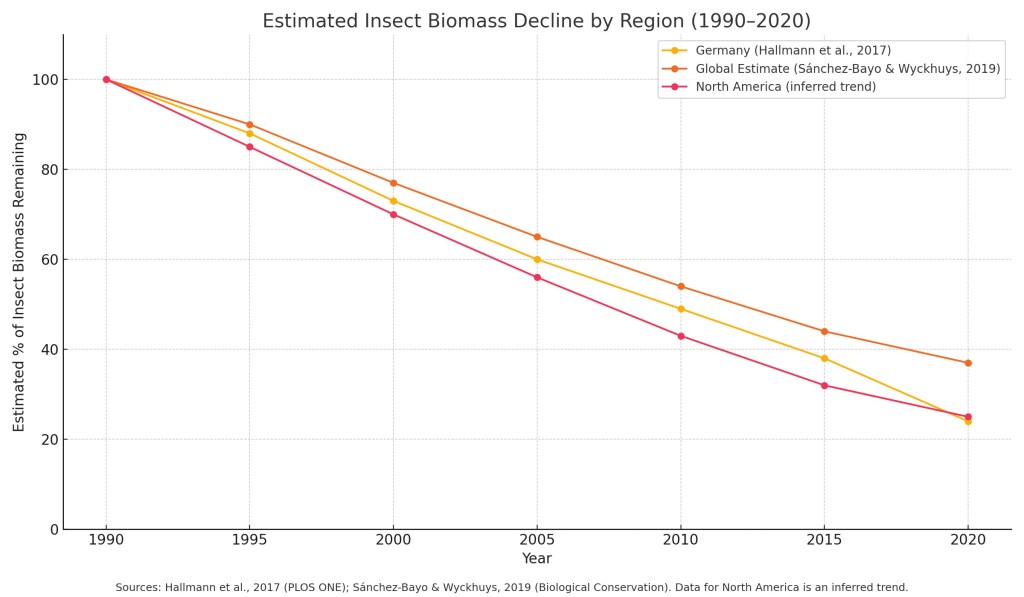
It’s not a conspiracy theory. It’s not a scare tactic. It’s science. A 2019 review published in Biological Conservation found that over 40% of insect species are declining globally. Many are heading toward extinction (Sánchez-Bayo & Wyckhuys, 2019). That’s nearly half of the world’s insect population disappearing in slow motion.
And yet, we rarely talk about it.
The media will occasionally sound the alarm about bees or butterflies. While their decline is alarming in itself, this issue goes much deeper. We’re seeing a crash in biomass, meaning it’s not just fewer species, it’s fewer bugs, period. Less of them in our forests, fields, gardens, and skies. A separate study in Germany recorded a 76% drop in flying insect biomass over nearly three decades (Hallmann et al., 2017). Though that’s Europe, similar trends are unfolding in parts of the U.S., too.
What’s driving this?
Habitat destruction, monoculture farming, pesticide use (particularly neonicotinoids), urban sprawl, light pollution, and climate change all share the blame. We’ve basically engineered a world that’s hostile to the very creatures that help sustain life on Earth.
Here’s why this should scare us:
No insects means no pollination. No pollination means no fruit, no vegetables, no coffee, no chocolate, and a whole lot of economic pain.
No insects means no food for birds, amphibians, reptiles, or fish. Entire food chains start to break down.
No insects means our soil stops recycling nutrients, our dead plants stop decomposing, and our planet’s ecosystems fall apart.
This isn’t just about losing bees.
This is the unraveling of the web of life.
And it’s happening quietly.
If the oceans were losing 40% of their fish, we’d be calling it collapse. If we lost three-quarters of all birds in a decade, the situation would also be deemed a collapse. But because bugs are small, easy to ignore, and let’s be honest—not always likable, their loss slips under the radar.
But here’s the truth:
Without insects, we don’t eat. We don’t survive.
So what can we do?
– Stop spraying pesticides on every blade of grass.
– Plant native flowers and leave wild spaces untouched.
– Support organic and regenerative farming practices.
– Educate others before the silence becomes permanent.
The decline in insect populations isn’t the end of the world yet. However, it could signify the beginning if we don’t listen. Nature is whispering. It’s time we stop tuning her out.
Sources
Sánchez-Bayo, F., & Wyckhuys, K. A. G. (2019). Worldwide decline of the entomofauna: A review of its drivers. Biological Conservation, 232, 8–27. https://doi.org/10.1016/j.biocon.2019.01.020
Hallmann, C. A., et al. (2017). More than 75 percent decline over 27 years in total flying insect biomass in protected areas. PLOS ONE, 12(10). https://doi.org/10.1371/journal.pone.0185809

 C1INE CREW
Leave a comment