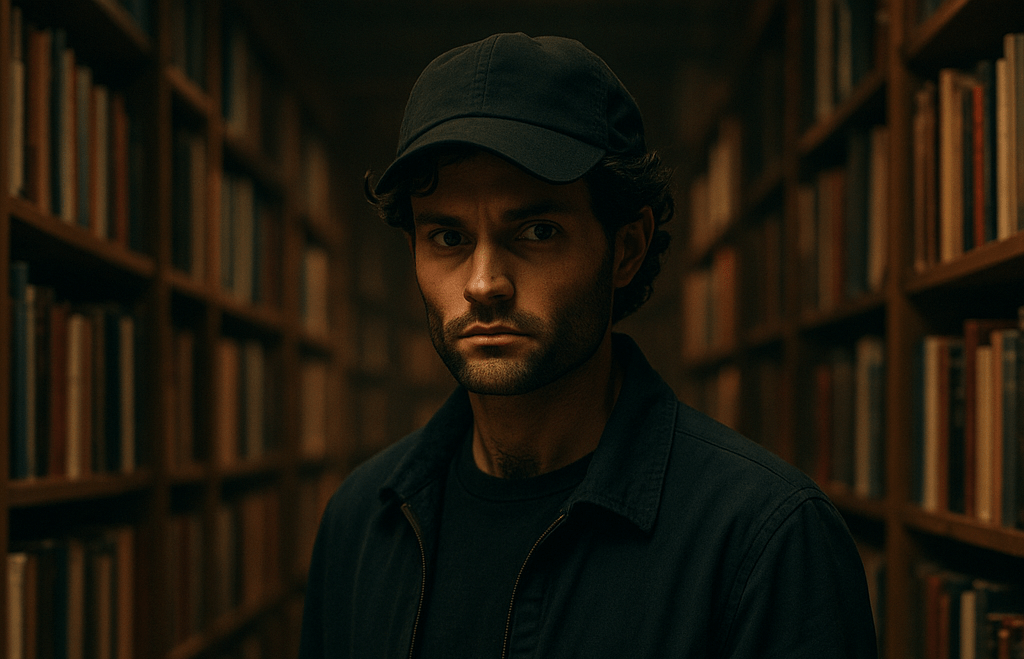

Joe Goldberg muttered his first internal monologue behind a bookstore counter in Season 1. From that moment, Netflix’s You pulled us into the unsettling intimacy of a killer. He doesn’t just stalk his victims—he narrates it like a love story. Over five seasons, the show evolved from a psychological thriller into a critique of romantic idealization. It also targets toxic masculinity and society’s dangerous habit of excusing charm for goodness.
Season One: The Boy Next Door From Hell
In the debut season, Joe meets Beck—and so begins the slow unraveling of her life under the guise of affection. Joe presents himself as a sensitive intellectual. He is the guy who “just wants to love right.” However, we quickly see that his love is possession disguised as protection. This season held up a mirror to audiences and asked a tough question: why are we rooting for him? It was the show’s first sleight of hand. It invited us into Joe’s head. We realize how easy it is to be seduced by a predator cloaked in poetry.
Season Two: Love, Actually… Is Terrifying
Then came Love Quinn. Season 2 flipped the narrative: the stalker got stalked. Love seemed like Joe’s equal—until she proved herself even more dangerous. It was a brilliant twist. We weren’t watching Joe become a better man—we were watching him realize he couldn’t even handle the reflection of himself. Love wasn’t a foil. She was a consequence.
Season Three: Domestic Nightmares
Season 3 is suburbia with a serrated edge. Joe and Love are married with a baby. They try their best to appear like a normal couple. However, they leave a trail of blood behind. It was less about romance and more about control, ego, and the lie of reinvention. Madre Linda looked perfect on the outside, but like Joe and Love, it was rotting from within. Their spiral mirrored every toxic relationship where two people try to “fix” one another while refusing to confront their own rot.
Season Four: A Killer’s Conscience
Season 4 felt like a genre shift—a whodunit where Joe wasn’t the only monster. Set in London, Joe becomes Professor Jonathan Moore and tries to “be good.” But redemption isn’t that simple. His enemies were no longer just people who “deserved” it—he was now surrounded by a world of elitist, corrupt figures, and somehow still managed to be the most dangerous among them. This season doubled down on the theme of accountability: how many second chances does a person deserve when they keep writing the same violent story?
Season Five: The End of the Illusion
By the final season, the truth becomes undeniable: Joe is not an anti-hero. He is not misunderstood. He is a symptom of a culture that excuses harm when it wears a pretty face and says the right things. Bronte’s role in ending Joe wasn’t just a plot device—it was symbolic of collective resistance. As the viral post suggests, Bronte carried the strength of all the women before her. She wasn’t just a final girl—she was a reckoning. And if you were mad at the ending, maybe it’s because You wasn’t just about Joe. It was about us—how we watch, justify, forgive, and repeat.
Personal Reflections
Joe represents the dangerous overlap of charm and control. He’s the man who weaponizes empathy, the friend who watches too closely, the partner who keeps receipts disguised as memories. And for a time, we were complicit—drawn in by the narration, the brooding glances, the bookish allure.
But You was never a love story. It was a warning.
Characters like Love, Marienne, Ellie, and Bronte each served as different voices in the echo chamber Joe built around himself—some victims, some survivors, some avengers. And by the end, the show challenged us to stop asking “What will Joe do next?” and instead ask, “Why did we care in the first place?”
Final Thought:
The most chilling moment of the finale wasn’t a death or a twist, it was a look. Joe Goldberg, blood on his hands, guilt in his bones, stares directly into the camera and says it:
“It’s You.”
It wasn’t just a clever nod to the show’s title. It was a confrontation. A mirror. A message. After five seasons of voyeurism, audiences justified his actions. They swooned over his brooding nature, calling it “love” when it was always obsession. Joe turns it back on us. We were complicit. We watched. We excused. We enjoyed it.
And the show, thankfully, didn’t reward us with a redemption arc. There was no tidy fairytale ending. No sudden transformation into a good man. Joe remains what he’s always been: a monster with a face society finds palatable.
It’s the same truth Penn Badgley has been preaching off-screen—pleading for viewers to stop romanticizing abusers and killers. The final season embraced that message fully and unapologetically. No soft filter. No blurred morality. Just a chef’s kiss of brutal honesty.
In the end, You was never really about Joe.
It was about us.

 C1INE CREW
Leave a comment